What Is Cloud Communications Standards Governance
The cloud communications market is expanding rapidly, and the protocols ...

Cloud connectivity is the mix of methods, technologies, and services that links your devices, networks, and users to the cloud platforms where your data and applications live.
Your connection method, whether public internet, a dedicated private circuit like AWS Direct Connect, or SD-WAN, directly shapes performance, security, cost, and reliability.
The payoff of strong connectivity is scalability without new hardware, lower latency for voice and video, and tighter security from keeping sensitive traffic off the public internet.
As multi-cloud and hybrid setups become standard, well-managed connectivity keeps distributed workloads fast and secure, which is why many businesses choose managed services over building in-house.
A decade ago, the cloud was just a strategic option. Organizations could choose to migrate workloads to AWS or keep everything on-premise. The decision was binary and deliberate.
Today, that choice no longer exists. Most enterprises operate across a sprawl of cloud platforms, remote offices, distributed workforces, and connected devices, and the infrastructure holding all of this together is what separates successful organizations from those that experience constant bottlenecks and performance issues. That infrastructure is cloud connectivity.
The global cloud computing market reached $912 billion in 2025 and is forecast to grow to $1.6 trillion by 2030,1 and businesses supporting that growth depend on connectivity infrastructure that can evolve as rapidly as their cloud strategies do. Read on to learn what cloud connectivity is, why it matters for cloud performance, and how to find a solution that aligns with your organization's growth trajectory.
Cloud connectivity refers to the methods, technologies, and services that enable devices, networks, users, and systems to access and communicate with cloud-based resources. At its core, it is the connection between your business environment – whether an office, a data center, a remote workforce, or a fleet of connected devices – and the cloud platforms where your applications and data live.
Cloud connectivity isn’t a single technology. It includes everything from dedicated private connections, broadband access, and software-defined networking to the managed services that configure and maintain all of the above.

Network connectivity is the broader category within which cloud connectivity sits. Every cloud interaction – a VoIP call, a video conference, a CRM lookup – depends on a well-architected connectivity network to move data quickly and without interruption.
A high-performance connectivity network today should include:
The quality of your network connectivity directly determines the quality of your cloud experience. Need better infrastructure to support your cloud tools? Explore the CCA's Cloud Communication Providers Directory, which connects you with vetted vendors offering the full gamut of connectivity solutions.
The method a business uses to establish its cloud connection has direct implications for performance, security, cost, and reliability. Three primary approaches serve different business needs.
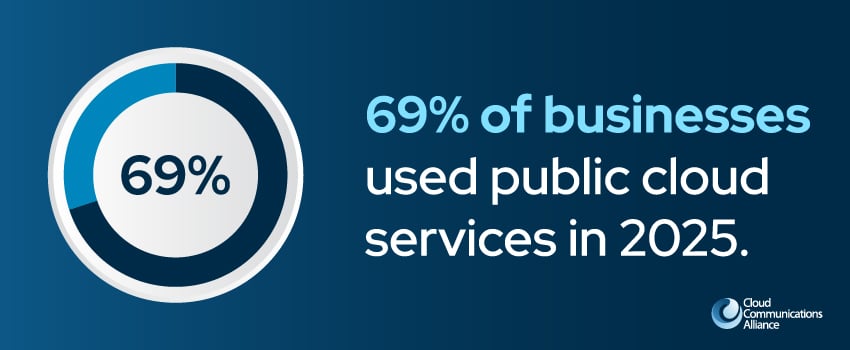
Routing cloud traffic over the public internet is the most common approach, with 69% of businesses embracing public cloud services in 2025.3 It’s fast to deploy and cost-effective, but performance can be variable, and security depends on encryption controls. This method is usually enough for daily workloads and smaller businesses, but can introduce risk for latency-sensitive applications or regulated data.
Dedicated private connections, such as AWS Direct Connect or Azure ExpressRoute, route traffic over a private circuit. The result is low latency, predictable throughput, and a stronger security posture, making this approach standard for enterprises running mission-critical workloads in the cloud.
SD-WAN creates intelligent virtual connections that route traffic across multiple underlying links – broadband, MPLS, LTE – based on real-time conditions and policy rules. It gives organizations a more cost-effective path to reliable cloud connectivity by optimizing available resources rather than requiring new physical infrastructure.
The right connectivity model does more than keep your applications reachable. It shapes how quickly you can grow, how reliably your workloads perform, and how well your data stays protected. Three benefits stand out.
Cloud connectivity lets you expand computing power and storage on demand, without buying and provisioning physical hardware first. When a new office comes online or a workload spikes, you adjust capacity through your connectivity layer instead of waiting on procurement cycles. That elasticity is what lets cloud adoption keep pace with the business rather than constrain it.
Dedicated and private connections reduce latency and packet loss, which matters most for bandwidth-heavy, latency-sensitive workloads like voice, video conferencing, and large data transfers. Routing this traffic over predictable private circuits instead of the open internet smooths out the jitter and congestion that degrade real-time applications. The result is a more consistent experience for the people and systems that depend on those tools.
Private connectivity keeps sensitive traffic off the public internet, narrowing the exposure that comes with routing corporate data across shared infrastructure. For organizations handling regulated or confidential information, that reduced attack surface is often the deciding factor between a public-internet path and a dedicated one. Pairing private connections with consistent encryption and access policies gives you protection that holds up across every environment you connect.
Most enterprises today operate across AWS, Azure, Google Cloud, and multiple SaaS platforms simultaneously – often because they adopted applications independently over time. Multi-cloud connectivity refers to the architecture and services that enable secure, seamless communication between workloads running across multiple providers.
Make sure your multicloud connectivity strategy accounts for:
Multicloud connectivity can become fragmented without a deliberate strategy, where each cloud silo has its own access path and performance characteristics. Not only does this fragmentation increase complexity, it also reduces the agility that cloud adoption is meant to provide.
There are two main approaches for establishing cloud connectivity infrastructure: managed services – where a provider handles it all – or self-managed infrastructure that a business builds and operates internally.
Here’s how these options compare:
Managed connectivity services transfer the deployment, monitoring, and maintenance of connectivity infrastructure to a specialized provider. The provider handles everything about the environment, including circuit procurement, SD-WAN configuration, performance monitoring, and incident response – so your internal teams get enterprise-grade connectivity without requiring deep network engineering expertise in-house.
Managed services also provide access to current market knowledge about connectivity technologies, pricing, and vendor capabilities, which organizations building internal teams can struggle to maintain as the market evolves.
Organizations with large IT teams and specific customization requirements sometimes prefer to build and manage connectivity infrastructure directly. While this offers maximum control over design decisions and allows for more customization to meet organizational requirements, it also requires an ongoing investment in engineering talent and operational processes.
As cloud environments grow more complex, many businesses are finding the cost of maintaining specialized connectivity expertise difficult to justify against the cost of managed alternatives.
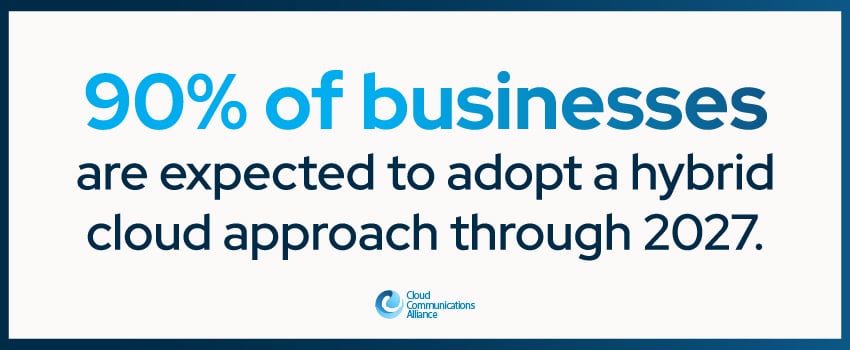
Hybrid cloud connectivity combines on-premise infrastructure with the cloud, enabling workloads, data, and apps to move between the two. Nearly all (90%) of organizations are expected to adopt a hybrid cloud approach through 2027,2 driven by the need to balance scalability, security, and regulatory compliance requirements.
Hybrid cloud connectivity makes it so that both environments work as one. Important factors to consider include latency between on-prem systems and cloud workloads, identity and access management that spans both environments, and failover architecture that keeps your systems going if either environment experiences disruption.
The Internet of Things has added an entirely new dimension to cloud connectivity requirements. Connectivity in IoT refers to the networks and protocols that enable physical devices – sensors, cameras, industrial equipment, smart building systems – to communicate with cloud platforms for data processing and control.
What is IoT connectivity in practice? It’s the combination of wireless protocols like 5G, LTE, Wi-Fi, and LoRaWAN, alongside network management infrastructure that keeps IoT device fleets online, secure, and generating usable data.
The biggest challenges in ensuring reliable IoT connectivity include:
If you’re seeking vetted providers for cloud connectivity solutions to support your IoT devices, check out the CCA's Cloud Communications Providers Directory. Our vendors are all fully vetted and have proven implementation experience across industries and deployment scenarios.
The cloud connectivity market spans network service providers, SD-WAN vendors, colocation facilities, cloud exchange platforms, and managed service providers. Regardless of the type of connectivity solution you’re looking for, make sure to evaluate these factors when comparing vendors:
Understand the latency, throughput, and availability thresholds your critical applications actually need – then evaluate solutions against those thresholds.
Determine whether your data classification or regulatory framework requires private connectivity and ensure that any solution meets those standards by default.
Cloud environments scale quickly, and your connectivity infrastructure needs to keep pace without requiring disruptive re-architecture.
Evaluate how well the solution will be able to integrate with your network equipment and security tooling to avoid fragmented operations.
The provider's support, responsiveness, and uptime commitments matter as much as the technical specification.
Cloud connectivity is the set of methods, technologies, and services that let your devices, networks, and users reach cloud-based applications and data. It works by establishing a path between your business environment, such as an office, data center, or remote workforce, and the cloud platforms where your workloads run. That path can be the public internet, a dedicated private circuit, or a software-defined connection that routes traffic intelligently. The model you choose determines the performance, security, and reliability of every cloud interaction.
Businesses typically reach the cloud three ways. The public internet is the most common and cost-effective, though performance can vary and security depends on encryption. Dedicated private connections, such as AWS Direct Connect or Azure ExpressRoute, run traffic over a private circuit for low latency and predictable throughput. SD-WAN creates intelligent virtual connections that route traffic across broadband, MPLS, and LTE links based on real-time conditions. Many organizations combine these approaches to match each workload's performance and security needs.
Strong cloud connectivity delivers three core benefits. Scalability lets you expand computing power and storage on demand without buying physical hardware first. Improved performance comes from dedicated connections that cut latency and packet loss, which matters for voice, video, and other bandwidth-heavy workloads. Enhanced security follows from private connections that keep sensitive traffic off the public internet and reduce your exposure. Together, these benefits let your infrastructure keep pace with cloud adoption instead of holding it back.
A dedicated cloud connection routes your traffic over a private circuit straight to a cloud provider, bypassing the public internet. Enterprises use it for mission-critical workloads that need low latency, predictable throughput, and a stronger security posture. Services like AWS Direct Connect and Azure ExpressRoute are common examples. It is the standard choice when consistent performance and reduced public-internet exposure matter more than the lower cost and faster setup of an internet-based path.
SD-WAN, or software-defined WAN, creates intelligent virtual connections that route traffic across multiple underlying links, including broadband, MPLS, and LTE. It selects the best path in real time based on current network conditions and policy rules, so latency-sensitive traffic like voice and video gets priority. This gives organizations reliable cloud connectivity without investing in new physical infrastructure, optimizing the links they already have. It is often the most cost-effective route to consistent performance across distributed sites.
Hybrid cloud connectivity links on-premise infrastructure with cloud platforms so workloads, data, and applications can move between the two. Organizations use it to balance scalability, security, and regulatory compliance, keeping some systems in-house while tapping the cloud for the rest. A sound hybrid setup depends on low latency between environments, identity and access management that spans both, and failover architecture that keeps systems running if either side goes down. The goal is to make both environments operate as one.
IoT connectivity is the networks and protocols that let physical devices, such as sensors, cameras, and industrial equipment, communicate with cloud platforms for data processing and control. It relies on wireless protocols like 5G, LTE, Wi-Fi, and LoRaWAN, plus management infrastructure that keeps device fleets online and secure. It matters because IoT deployments add scale and complexity: diverse hardware, strict latency needs, remote devices that are hard to reach, and limited on-device security. Connectivity has to handle all of that reliably.
Managing multi-cloud connectivity means architecting secure, seamless communication between workloads spread across providers like AWS, Azure, and Google Cloud. Focus on consistent security policies across every environment, optimized routing that minimizes latency and unnecessary public-internet hops, and centralized visibility into performance and incidents. Vendor flexibility matters too, so you can shift workloads without rebuilding your connectivity from scratch. Without a deliberate strategy, each cloud becomes its own silo, adding complexity and eroding the agility that cloud adoption is meant to provide.
Managed cloud connectivity services hand the deployment, monitoring, and maintenance of your connectivity infrastructure to a specialized provider. They are worth it for organizations that want enterprise-grade connectivity without building deep network engineering expertise in-house. The provider handles circuit procurement, SD-WAN configuration, performance monitoring, and incident response, and stays current on shifting technologies, pricing, and vendor options. Self-managing makes sense for teams with large IT staff and specific customization needs, but many businesses find the cost of in-house expertise hard to justify.
Cloud connectivity is the enabler of every cloud-based application, communication platform, and digital service your business delivers. As workloads become more distributed, device fleets grow larger, and multi-cloud architectures become the norm, the organizations that invest in robust, well-managed connectivity infrastructure will consistently outperform those that treat it as an afterthought.
Looking for infrastructure partners to support your cloud communications and connectivity needs? The CCA's Cloud Communications Providers Directory features providers with proven expertise in cloud connectivity, SD-WAN, managed services, and enterprise networking, so you can find the solutions you need to meet your goals.
If your business is shaping the future of cloud connectivity or cloud communications, we would love to have you involved. Apply for CCA membership today and join the global community driving the industry forward.
Sources:
Browse these posts below for the latest in cloud communications news and insights.